|
PHILHARMONICA. International Music Journal
Оформленная ссылка на статью:
MEI, J. (2025). Zhenya Komelkova’s Image in Tan Jianping’s Opera “The Dawns Are Quiet Here”. PHILHARMONICA. International Music Journal, 3, 13–26. DOI: 10.7256/2453-613X.2025.3.77039
Zhenya Komelkova’s Image in Tan Jianping’s Opera “The Dawns Are Quiet Here” /
Образ Жени Комельковой в опере Тан Цзяньпина «А зори здесь тихие»
Мэй Цзевэнь
ORCID: 0009-0000-5861-9314
кандидат искусствоведения
аспирант; институт Виды искусства (музыкальное искусство); Государственный музыкально-педагогический институт имени М.М. Ипполитова-Иванова
121357, Россия, г. Москва, р-н Фили-Давыдково, ул. Инициативная, д. 6 к. 1, кв. 149
MEI JIEWEN
PhD in Art History
Postgraduate student; Institute of Types of Art (Musical Art); M.M. IPPOLITOV-IVANOV State Music and Pedagogical Institute
121357, Russia, Moscow, Fili-Davydkovo district, Initiativnaya str., 6, room 1, sq. 149

|
912876563@qq.com
|
|
 |
Другие публикации этого автора
|
|
|
DOI: 10.7256/2453-613X.2025.3.77039
EDN:
EZYDSU
Дата направления статьи в редакцию:
25-03-2025
Дата публикации:
02-12-2025
Abstract: This study analyzes the musical and dramatic features of the opera The Dawns are Quiet Here by Chinese composer Tang Jianping, based on the novella by Boris Vasilyev. The work examines the interaction of Russian literary tradition with Chinese musical style, as well as the expressive means used in the opera to reveal the characters’ personalities. Special attention is given to the musical image of Zhenya Komelkova, one of the opera’s key characters. Her vocal line, the evolution of the musical accompaniment, and her dramatic role in the plot are explored. Key scenes are considered in which Zhenya goes from cheerfulness to the realization of her tragic fate. The article analyzes vocal and instrumental means, such as timbral solutions, harmonic content, and rhythmic changes that enhance the emotional impact on the listener. The study employs methods of music-theoretical analysis to identify features of vocal parts and orchestral accompaniment. A comparative method is used to study the musical language of the opera in the context of Russian and Chinese traditions. The novelty of the research lies in the detailed examination of the interaction between Chinese musical tradition and the Russian literary original. The analysis of Tang Jianping’s opera demonstrates how the composer adapts traditional methods of Chinese musical theater to convey the dramatic line of Russian classics. An important contribution is the study of Zhenya Komelkova’s vocal part, her evolution throughout the work, and the musical means used to convey her emotional state. The main conclusions of the conducted research are the identification of musical techniques that contribute to the creation of vivid artistic images and the revelation of the dramaturgical role of music in shaping the emotional impact on the audience. An original methodology for analyzing military themes in musical works has been developed. The study opens new perspectives for investigating intercultural dialogue in contemporary music.
Keywords:
Russian literature, vocal analysis, opera, musical dramaturgy, Zhenya Komelkova, Tan Jianping, literary classics, China, Russia, Opera
Аннотация:
Предметом исследования является анализ музыкально-драматургических особенностей оперы «А зори здесь тихие» китайского композитора Тан Цзяньпина, основанной на повести Бориса Васильева. В работе рассматриваются взаимодействие русской литературной традиции с китайским музыкальным стилем, а также средства выразительности, использованные в опере для раскрытия характеров персонажей. Особое внимание уделяется музыкальному образу Жени Комельковой, одной из ключевых героинь произведения. Исследуются её вокальная линия, эволюция музыкального сопровождения и драматургическая роль в развитии сюжета. Рассматриваются ключевые сцены, в которых Женя проходит путь от жизнерадостности к осознанию собственной трагической судьбы. В статье анализируются вокальные и инструментальные средства, такие как тембровые решения, гармоническое наполнение и ритмические изменения, способствующие усилению эмоционального воздействия на слушателя. В исследовании применяются методы музыкально-теоретического анализа, позволяющие выявить особенности вокальных партий и оркестрового сопровождения. Используется сравнительный метод для изучения музыкального языка оперы в контексте русской и китайской традиций. Анализируется партитура произведения, а также современные научные исследования.
Новизна исследования заключается в детальном разборе взаимодействия китайской музыкальной традиции с русским литературным первоисточником. Анализ оперы Тан Цзяньпина демонстрирует, как композитор адаптирует традиционные приёмы китайского музыкального театра для передачи драматической линии русской классики. Важным вкладом является изучение вокальной партии Жени Комельковой, её эволюции в ходе произведения и использования музыкальных средств для передачи её эмоционального состояния. Основными выводами проведённого исследования является выявление музыкальных приёмов, способствующих созданию ярких художественных образов, и раскрытие драматургической роли музыки в формировании эмоционального воздействия на зрителя. Разработана оригинальная методология анализа военной тематики в музыкальных произведениях. Исследование открывает новые перспективы в изучении межкультурного диалога в области современной музыки.
Ключевые слова:
Опера, Россия, Китай, литературная классика, Тан Цзяньпин, Женя Комелькова, музыкальная драматургия, опера, вокальный анализ, русская литература
The opera The Dawns are Quiet Here is a significant work in modern musical culture. Created by Chinese composer Tang Jianping in 2015, its plot is based on Boris Vasiliev’s novel of the same name, which describes the feat of five young female anti-aircraft gunners during the Great Patriotic War. The uniqueness of this opera lies in its being the first Chinese musical drama dedicated to the events of World War II, thereby connecting the historical destinies of Russia and China [1].
The work on the opera was carried out in a short time: its score was completed in less than a year, on August 15, 2015. Wang Fan wrote the libretto for the opera, and the director of the first production was Wang Xiaoping. The premiere took place on November 5, 2015, and was timed to coincide with the celebration of the October Revolution, which emphasized its symbolic significance for both China and the countries of the former USSR [3].
The production of the opera The Dawns are Quiet here was timed to coincide with the 70th anniversary of the Victory in the Great Patriotic War and the War of Resistance of the Chinese People against the Japanese invaders. According to Deng Yijiang, deputy director of the Beijing National Center for Performing Arts, this opera was “a tribute to all the heroes who sacrificed their lives” and a reminder of the importance of preserving the memory of the war.
The musical and dramatic solution of the opera is based on the synthesis of Russian and Chinese musical traditions. The composer used elements of Russian folklore, intonational allusions to Soviet military-patriotic songs, and classical Russian operas. The main musical idea of the piece was a theme that reflects the Russian identity. It varies depending on the situation, accompanying key dramatic moments, for example, the scene of girls wading through a swamp [5].
The opera consists of two acts and 60 scenes, with a total duration of about 2.5 hours. The main characters remain Sergeant Vaskov and five female soldiers: Rita, Lisa, Sonya, Zhenya, and Galya. The musical design of the opera combines the aesthetics of Russian music with elements of traditional Chinese opera. Russian music emphasizes the dual nature of the work: on the one hand, it is a Chinese interpretation of Russian classics; on the other hand, it is a deep exploration of preserving Russian identity in musical language [3].
As researcher Cui Yajun notes, the Chinese audience perceives The Dawns Are Quiet Here as an interpretation of the Russian classics in its original Chinese arrangement. It combines grandiose battle scenes, lyrical arias, and deep tragedy, which makes it a vivid example of modern musical theater in China [8].
It is important to note that the opera lacks a naturalistic depiction of war. The enemy is symbolized by nameless shadows embodying the brutality of war. The disclosure of human destinies, internal struggle, and heroic choice occupies the central place. The topic of the death of young girls turned out to be especially important for the Chinese audience, since in China, the issue of gender disparity and the role of women in history is perceived especially acutely [6].
Thus, Tang Jianping’s opera The Dawns are Quiet Here is a unique phenomenon in which the traditions of Russian and Chinese musical drama are intertwined into a single heroic-epic composition. It not only reveals the theme of war but also touches on universal issues of memory, honor, and the tragic fate of heroes, making the work significant for a wide international audience.
Zhenya Komelkova is one of the brightest and most memorable characters of The Dawns are Quiet Here. In Boris Vasiliev’s story, she appears as a brave, determined, and cheerful girl who, despite tragic circumstances, retains inner strength and a love of life. In Tang Jianping’s operatic version, her image was musically embodied, emphasizing the heroine’s emotional depth and tragic fate.
Zhenya Komelkova holds a special place among the five female anti-aircraft gunners. She stands out not only for her external beauty — her friends admire her magnificent red hair — but also for her lively, energetic character. Zhenya is a natural leader who unites people around him, inspires them, and supports them in difficult moments [7].
As noted by Wang Fan, the librettist of the opera, Zhenya embodies love and beauty, opposed to war and destruction. Her image symbolizes sacrifice and perseverance, but unlike other heroines, she retains some naivety and romanticism even in the most critical moments. This makes her the most emotionally intense role among all the girls [2].
In the opera score, the composer uses contrasting musical means: light, dance motifs at the beginning give way to deep, saturated harmonies in scenes of internal conflict, and the culmination of her part reaches its highest emotional peak at the moment of self-sacrifice.
Zhenya’s past is full of tragedies: her family — her mother, sister, and little brother — were shot in front of her eyes when the Germans destroyed the families of the Red Army commanders. She miraculously survived, hiding in an Estonian woman’s house, but this loss changed her forever. Komelkova realized that her life now belongs to the war, and perhaps this was the reason for her desperate courage. Instead of breaking down, Zhenya maintains a cheerful, ironic attitude, skillfully hiding his pain [7].
The opera reveals the love aspect of her fate – her feelings for the colonel. Her arias contain words of passion and pain: “How I suffer, I cannot be with you,” “My colonel, my officer, my man.” However, Zhenya realizes that this novel is doomed, which adds an additional tragedy to her image. Here, her vocal line becomes more extended, saturated with wide intervals, conveying the heroine’s inner struggle.
In this episode, Zhenya expresses her deep affection for the colonel, calling him “my officer, my man,” underscoring not only her personal feelings but also her respect for him as a military commander. However, she realizes their connection is impossible, which creates a powerful emotional gap between the characters.
Zhenya’s part begins with a smooth, long melody that conveys tenderness and love. The vocal line develops in waves, with a gradual rise and fall, which emphasizes its fluctuations between hope and sadness. (Figure 1)
In the first phrase (“But I love you so much”), the melody moves steadily, with small jumps, creating a sense of lyrical recognition. In the second part (“my colonel, my officer, my man”), the vocal line becomes more tense, and there are interval jumps that increase the drama. The upward movements of the melody symbolize Zhenya’s desire to express her feelings, but then it descends, creating a sense of humility before fate.
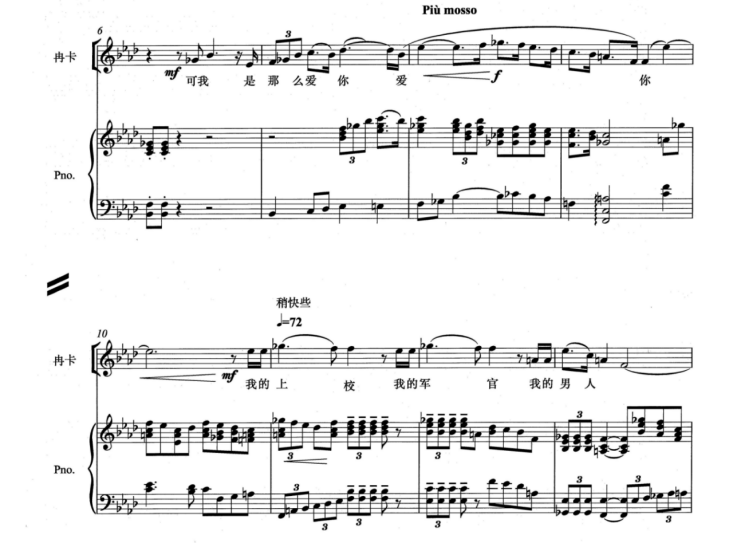
Figure 1. Vocal expression and drama in Zhenya Komelkova's aria
The key contains flats, which gives the melody softness and melancholy.
In the piano part, the chords are accompanied by trioles, which create a slight instability, as if Zhenya is vacillating between emotions. At the beginning, the tempo is moderate, but the instruction Più mosso (“a little more mobile”) makes the music move faster, reflecting the heroine’s increasing excitement. The second part (with "my colonel...") has a clear rhythm, with accents that emphasize the importance of each word.
This fragment is a key moment of emotional tension in Zhenya Komelkova’s aria. In it, she addresses the colonel, expressing doubt, hope, and pain at the same time. Figure 2. The first note of the vocal part (“Ah ...”) is drawn out, creating a feeling of longing, surprise, and inner excitement. This is followed by a melodic line with short notes and a gradual rise, which gives the phrase the intonation of a question (“Are you calling me?”).
The melody's simplicity emphasizes the sincerity and emotion of the moment.
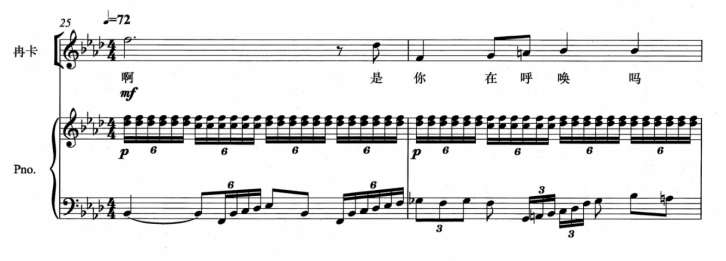
Figure 2. Are you calling me?" – a moment of expectation and anxiety in Zhenya Komelkova’s aria
The piano part is based on a fast, even repetition of the sixteenth notes, creating a pulsating tension.
The left bass notes sound heavy, maintaining a gloomy atmosphere. The contrast between the smoothness of the vocal line and the insistent rhythm of the accompaniment creates the effect of an internal struggle. Expectation and anxiety – “Ah...” should sound with a slight tremor, conveying a sigh, surprise, and hope. Uncertainty – “Are you calling me?” is performed with a gradual increase in dynamics, as if Zhenya is really waiting for an answer. There is a fine line between hope and disappointment – the singer’s voice should be soft, but filled with deep feeling.
This moment demonstrates not only Zhenya’s love affair but also her emotional vulnerability. The music highlights her inner state through a combination of soft vocals and pulsating accompaniment. The scene is filled with expectation and slight dramatic tension, which is important for character development.
This moment of Zhenya Komelkova’s aria expresses the passion, tenderness, and tragic doom of her feelings. It combines emotional intensity, sensuality, and awareness of the inevitable separation. (Figure 3)
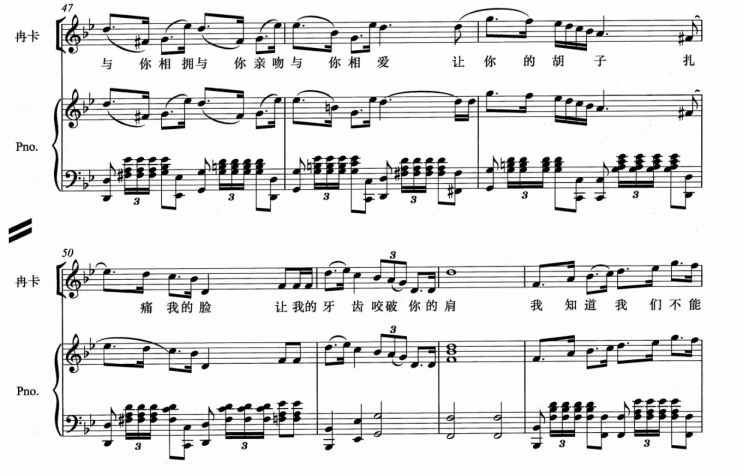
Figure 3. The last moments of passion
Figure 3. The last moments of passion
The opening phrase (“Hug you, kiss you, love you”) has a smooth, humming melody that creates a feeling of tenderness and affection. The gradual rise in melody highlights the passion and emotional intensity. In the following phrases (“May your beard prick my face,” “May my teeth hurt your shoulders”), the vocal line becomes more jerky, which conveys her desire to memorize every detail of this moment.
In the last sentence (“I know we’re not...”), the intonation changes – delayed notes appear expressing regret and the inevitability of separation. The chords in the piano’s left-hand sound sharp, forming three-note beats that create a pulsating rhythm that conveys the tension of the scene. On the right hand, the accompaniment is based on arpeggios, giving the vocal line lightness and dreaminess and creating a contrast with the drama of the text.
The use of trioles and accents highlights the pulsating energy of the moment. Passion and tenderness – in the first phrases, the voice should sound soft, with a slight vibrato, conveying the intimacy of the moment. Sensuality and playfulness – in the lines about the beard and teeth, it is important to convey a slight flirtatiousness, but with a touch of desperation. Doom and farewell – the last phrase should sound with fading, creating the effect of awareness of the inevitable separation.
This moment is the culmination of Zhenya’s personal emotional line. Musically, he combines lyrics, passion, and tragedy, emphasizing her inner struggle between love and awareness of the imminent end. The performer must convey the full range of feelings – from happiness to pain, making this episode especially expressive.
The minor key adds a touch of sadness, and the aria’s climax is marked by a crescendo (increasing volume), heightening the emotional tension of the scene. Zhenya realizes that her love is doomed, but accepts this fate with dignity.
The musical scene is based on a gradual increase in emotional tension:
The scene begins at a slow, thoughtful pace that conveys her inner doubts. The orchestra sounds muffled, dominated by the strings' low registers, creating the effect of painful reflection.
Zhenya’s main vocal line is smooth, filled with long, drawn-out notes, which highlight her inner struggle. Her party is based on wide intervals, creating a sense of pent-up feeling.
Recurring motifs – the composer uses repeated repetitions of the name “Eugene” in the colonel’s vocal line, which emphasizes his tenderness and desire to hold her, but at the same time, the realization of the impossibility of being together.
The climax of the scene is when the female vocal part soars into the upper register, expressing the peak of her emotions, with the words “How I suffer, I can’t be with you.” This is accompanied by a powerful orchestral build-up, creating a cathartic effect.
The finale of the scene is a decrease in dynamics, a return to a thoughtful pace. The last notes in Zhenya’s part are played on the breath, symbolizing her humility to fate.
Zhenya’s scene with the colonel is not only a love story but also a symbolic farewell to personal happiness. Zhenya realizes that war does not give the right to love, and accepts it with dignity.
Zhenya’s relationships with other girls are based on trust and sincerity. She is especially close to Rita Osyanina, who becomes her friend and ally. Although their characters are different — Rita is more restrained, Zhenya is more emotional — together they form the kind of core of the team. Unlike Osyanina, who is closed in her grief, Komelkova expresses her feelings openly, be it joy or pain.
Like the rest of the heroines, Zhenya’s fate is tragic. In a key scene of the novel and opera, she consciously decides to divert the attention of the saboteurs to save the wounded Rita. Zhenya uses her speed and agility to lure enemies after her, but her plan turns out to be suicidal. She dies, realizing that her sacrifice gives her friend a chance to last longer [7].
This moment became one of the most emotionally intense scenes in Tang Jianping’s opera production. Musically, Zhenya's farewell-to-life scene is full of dynamic contrasts: from lyrical motifs that emphasize her inner world to sharp, dramatic chords that symbolize the approaching end. The composer uses a high soprano register, which makes Zhenya’s aria especially intense and expressive [4].
At this moment, her party is filled with both determination and inner pain. She doesn’t just go to certain death — she does it consciously, realizing that there is no other way out.
This episode represents a moment of intense emotional tension between the characters. Contrasting dynamic transitions, sharp phrases, and dense orchestral textures emphasize the scene’s dramatic essence.
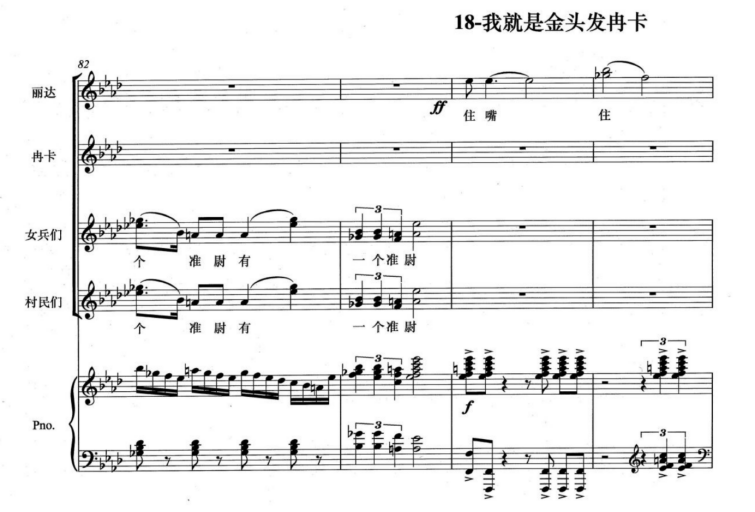
Figure 4. The contrast of fear and determination: an analysis of vocal interaction
Rita and Zhenya sing short, jerky phrases (“Shut up!”), and at high dynamics (fortissimo), which conveys the sharpness and urgency of the moment. Zhenya enters immediately after Rita, which creates the effect of a tense dialogue, as if she were interrupting a friend. A female choir (female soldiers, female villagers) joins after the main characters, adding a collective awareness of the importance of what is happening. Their vocal line is longer, but dynamically emphasizes anxiety (“There is a senior”).
The piano part is full of short, sharp chords that create a sense of anxiety and haste. The accompaniment is dominated by trioli, which enhance the rhythmic tension. The dynamics increase dramatically toward the end, emphasizing the conflict and the significance of the words. Sharpness and categoricality – the phrases “Shut up!” should sound harsh, harsh, perhaps with a slight forcing of the voice. Feeling of anxiety – the voice should not be absolutely stable; shades of excitement are acceptable. Collective Awareness – The female chorus adds depth to the scene, showing that the conflict goes beyond personal dialogue.
This moment is one of the most intense in the scene of interaction between Rita, Zhenya, and the rest of the characters. The composer uses sharp rhythmic patterns, dense orchestral texture, and short, accented vocal phrases to convey the dramatic urgency of the moment.
Rita sings the phrase “You’re not ashamed to say such things” on a relatively flat but tense line, expressing indignation and protest. Her party sounds like a rebuke, emphasizing the moral side of the situation.
Zhenya joins fortissimo (“Say, say”) immediately after that, and her part is filled with power and dynamic bursts, requiring an energetic performance. This is not just a remark, but a call to action. In this scene, Zhenya dramatically changes her mood – her voice sounds assertive, with clear rhythmic accents that emphasize her determination. The piano part is dominated by sharp, accented chords that create a rhythmic pulse of tension. Alternating trioles in the accompaniment establishes a sense of movement, haste, and the accelerated rhythm of combat. The dynamics increase dramatically by the time Zhenya joins, emphasizing her impetuous decision to rush into battle.
Sharpness and determination – Zhenya must perform her part with force, without hesitation, to express her desire for action. Defiance and pressure – the emphasis on the words “Say, say” should sound like a challenge to fate, a desperate but confident step forward. The contrast with Rita’s previous remark is that if Rita’s part sounds rather condemnatory, then Zhenya responds aggressively, without holding back emotions.
This moment of the scene is a sharp emotional turning point, a moment of decision-making. Zhenya doesn’t think anymore; she acts. The music highlights this transition through sharp accents, powerful chords in the accompaniment, and forced vocal delivery.
The phrase “I’m not afraid” is performed in a relatively low register, on steady notes, which gives it a sense of firmness and confidence. This is followed by “I’m Eugene with golden hair” – the melody becomes smoother, with slight upward jumps, which creates a sense of pride and awareness of one’s own individuality. The repetition of “Beautiful Zhenya” is like her personal parting words to herself, a confirmation that she remains true to herself even in the face of death.
In this scene, the orchestra sounds minimalistic – sustained chords emphasize the strength of the vocal line. The low, almost silent notes in the accompaniment create a sense of tragic inevitability. The lack of active rhythmic movement makes this moment even more expressive – attention is focused on Zhenya’s words. Firmness and confidence – the voice should sound steady, even, without excessive vibration. Pride and acceptance of fate – it is especially important to convey in the line “I am Eugene with golden hair” – this is not a cry, but a conscious statement. The fine line between strength and farewell – the last words should sound calm, but with a touch of tragic beauty.
This moment is the culmination of the image of Zhenya Komelkova. Here, she accepts her fate with pride and inner dignity. The musical minimalism and emphasis on the vocal line emphasize its power, making the scene one of the most memorable in the opera. The phrase “I won’t be sad or regret it” has a smooth, confident melody, without sudden jumps, that emphasizes the heroine’s calmness and awareness. “I believe in my heart” – the vocal line rises slightly, symbolizing Zhenya’s confidence and firm belief. In the next fragment, “I don’t need sympathy or protection,” the intonation becomes firmer, almost harsh, and the rhythm becomes clearer. This highlights the heroine’s resilience and her unwillingness to be pitied. The final phrase “But I still want to thank you, my friend” softens the emotional intensity, and the melody becomes more extended, filled with warmth and gratitude.
The phrase “Come on” is repeated several times, creating a sense of defiance and readiness for the last fight. The final phrase “I’m here” is sung on a high note, which highlights her cry, the last challenge to the enemy.
The vocal part is extremely concise, but filled with a huge emotional charge – Zhenya does not beg, does not cry, but asserts his presence, accepting fate. The rhythmic structure of the accompaniment consists of clear trioles that create a marching tension resembling an alarm pulse. The piano sounds with repeated chords, like an echo of the approaching inevitable end. The dynamics are forte first, then mezzo-forte, creating the effect of a dramatic climax.
Determination and courage – the words “Come on” should not sound like a request, but like a challenge. Heroism and tragedy – “I’m here” should sound intense, sharp, at the limit of the emotional range. The last cry before death – the voice should be as intense as possible, perhaps with a slight boost, conveying an extreme degree of tension.
The tempo accelerates dramatically, and a marching rhythm appears, but not solemnly, with a hint of anxiety. The orchestra uses bright, contrasting dynamic transitions, changing jerky chords to long, stringy notes, conveying a sense of impending disaster. The musical accompaniment acquires marching features, but not in a solemn, but in a slow, mournful tempo.
The orchestra uses thick low registers, creating a sense of impending tragedy. Zhenya’s vocal line includes long, drawn-out notes, as if reflecting her last breath.
This scene uses harsh harmonies, expressive vocal jumps, and dramatic pauses, creating an effect of absolute tension and tragedy. This is one of the most powerful musical episodes of the opera, conveying the heroine’s understatement, tension, and tragic ending.
The beginning of the aria (“Apple trees and pears bloomed”) sounds smooth and melodious, creating a feeling of lightness and light sadness. Zhenya sings this phrase in the middle register, which gives the vocals softness and warmth.
The phrase “The mists have drifted over the river” has longer notes that symbolize movement, but in the context of the scene, it also foreshadows a tragic ending.
Choral voices pick up the melody, creating the effect of collective memory, as if the song were an echo of the past.
The piano part supports the vocal line with smooth, chordal beats, emphasizing the marching character of the original song. However, the tempo is slower here, which makes the performance more nostalgic.
The accompaniment uses a gradual increase in dynamics, creating an effect of excitement, as if the music is preparing for an inevitable drama.
Chant phrases appear in the choral parts, giving the scene a touch of folk song while conveying a sense of sad inevitability.
The use of Katusha in this episode not only highlights Zhenya’s national identity but also turns her image into a symbol of fading youth, sacrifice, and the memory of a life that can no longer be returned. At this moment, the heroine’s voice sounds especially vivid, conveying not only memories but also her farewell to life.
Composer Tang Jianping uses repetitive rhythms in her last scene, resembling a heartbeat that gradually fades. This technique enhances the emotional perception of the scene and creates a powerful sense of fatality and inevitability [9].
At this point, the music abruptly stops, creating the effect of emptiness. The last chords are the low, drawn-out sounds of cellos and double basses, symbolizing the passing of life.
As a result, Zhenya Komelkova’s death is one of the most powerful scenes in opera, where the composer uses the full arsenal of musical means to convey the tragedy, heroism, and inevitability of her fate.
Zhenya’s death, like the deaths of other girls, shows that war does not spare anyone, especially those who are willing to sacrifice themselves for others. However, her departure is not in vain: her image reflects the strength of spirit that allows physically weak but mentally strong people to become heroes.
Zhenya’s ending is tragic yet majestic. In her last scene, a chorus is heard reflecting the collective memory of her feat. Her image, as in the original literary work, remains a symbol of fortitude, love of life, and readiness for heroic deeds.
The image of Zhenya Komelkova in Tang Jianping’s opera retains the key features described in Vasiliev’s story: her courage, cheerfulness, and self-sacrifice. However, in the musical interpretation, the emphasis is on the emotional disclosure of her personality through vocal parts and orchestral accompaniment. In this sense, the opera complements the literary source, making Zhenya’s tragedy even deeper and more penetrating.
The composer endowed her vocal part with contrasting musical means. This evolution highlights the complexity of the heroine’s inner world, her struggle between memories of the past, the hope of love, and the inevitable realization of her own sacrifice. Unlike other characters, her image is most emotionally revealed through music – from vivid lyrical fragments to the harsh dramatic accents accompanying her death.
The musical structure of Zhenya’s part emphasizes her individuality and strength of character. Her last scene is not just a moment of tragic death, but also a symbol of sacrifice, embodied in a powerful orchestral development and culminating vocal rise. Zhenya’s death becomes one of the opera's most emotionally intense scenes, in which her inner struggle and final acceptance of fate are conveyed through vocal intonations, dynamic leaps, and contrasting timbres. Thus, Zhenya Komelkova appears not only as one of the heroines of the war drama, but also as a powerful symbol of resistance, love of life, and dedication.
Статья публикуется в одобренном рецензентами варианте (после получения положительной рецензии, рекомендующей рукопись к публикации) с исправлениями автора (внесенными им после получения замечаний редактора, если такие были).
Рецензия опубликована в открытом доступе непосредственно за текстом самой статьи. Все варианты авторских исправлений хранятся в депозитарии издательства и могут быть доступны по требованию уполномоченных организаций.
Прочитать рецензию на эту статью
References
1
. Wan, K. (2020). The opera "The Dawn Is Quiet Here" by Tan Jianping: The history of creation and features of musical dramaturgy. Art Education and Science, 3(24), 161-167. https://doi.org/10.34684/hon.202003019
2
. Wan, F. (2017). It's love, just love. Script, 7, 57.
3
. Guo, C. (2020). "The Dawn Is Quiet Here...": The military story by B. Vasilyev and the opera by Tan Jianping in the context of contemporary Chinese culture. In Culture. Science. Creativity: Proceedings of the XIV International Scientific and Practical Conference dedicated to the 75th Anniversary of the Great Victory and the 45th Anniversary of the Belarusian State University of Culture and Arts (pp. 43-48). Belarusian State University of Culture and Arts.
4
. Liu, Y. (2022). Interpretation of female images in the opera "The Dawn Is Quiet Here." Bulletin of the International Centre of Art and Education, 4, 309-318.
5
. Liu, Y. (2020). "The war has no female face": On the question of heroic women captured in the world artistic heritage. In Ad Rupturam: Proceedings of the International Scientific and Practical Conference (pp. 263-269). Magarin Oleg Grigoryevich Publishing.
6
. Sharipova, M. A. (2016). Female images in the story "The Dawn Is Quiet Here..." by B. Vasilyev. Scientific Notes of the Khujand State University named after Academician B. Gafurov. Series of Humanities and Social Sciences, 4(49), 51-55.
7
. Shishkin, V. A. (2021). The anthropology of the personality of sergeant Vaskov and girls in the story "The Dawn Is Quiet Here..." by Boris Vasilyev. In Russia and Global Development Trends: Materials of the All-Russian Scientific and Practical Conference with International Participation (pp. 127-140). Omsk State Technical University.
8
. Cui, Y. (2015). The dawn is silent, and time is eternal. Opera, 12, 15-19.
9
. Zhu, J. (2019). Applied and manipulative characteristics of recitative at dawn. Journal of Xi'an Conservatory of Music, 4, 74-79.
10
. Li, Z., & Krasovskaya, E. P. (2017). Programmatic works of Chinese composers as a subject of study in piano classes in higher educational institutions of China. Musical Art and Education, 4, 97-111.
11
. Wu, H. (2015). The May Fourth Movement and its role in the process of forming Chinese art song. Northern Music, 282, 3-5.
12
. Wu, Y. (2008). Research on ancient stringed instruments. Shanghai Conservatory of Music Publishing.
13
. Huang, T. (2002). Chinese art songs and aesthetic concepts prevalent in China. Bulletin of Northeast Normal University, 5, 150-153.
14
. Hu, T. (2001). Chinese art songs of the 1920s and 1930s. Bulletin of Xi'an Conservatory of Music, 2, 10-16.
15
. He, L. (1986). On the problem of voices set in a European manner. Report on Literature and Art, 1, 59-63.
16
. Cao, K. (n.d.). Guo Wenzheng: After leaving the dormitory of the Central Conservatory, he has dominated the Chinese music scene for over 30 years. https://www.thepaper.cn/newsDetail_forward_9745475
17
. Chen, Y. (2019). The intersection of East and West in contemporary Chinese music. Music & Letters, 100(3), 439-463.
18
. Everett, Y. U. (2018). Reconfiguring myth and narrative in contemporary opera. Journal of the American Musicological Society, 71(3), 795-830.
19
. Frolova-Walker, M. (2020). Russian music and nationalism: From Glinka to Stalin. Journal of the Royal Musical Association, 145(1), 229-236.
20
. Steingo, G. (2021). After the end of contemporary music. Journal of the American Musicological Society, 74(1), 135-193.
Библиография
1. Frolova-Walker, M. Russian Music and Nationalism: From Glinka to Stalin / M. Frolova-Walker // Journal of the Royal Musical Association. – 2020. – Vol. 145, No. 1. – P. 229-236.
2. Steingo, G. After the End of Contemporary Music / G. Steingo // Journal of the American Musicological Society. – 2021. – Vol. 74, No. 1. – P. 135-193.
3. Цао, Кефан. Го Вэньцзин: выйдя из общежития мастера Центральной консерватории, он уже более 30 лет доминирует на китайской музыкальной сцене / Цао Кефан. – URL: https://www.thepaper.cn/newsDetail_forward_9745475 (дата обращения не указана).
4. Chen, Yi. The Intersection of East and West in Contemporary Chinese Music / Yi Chen // Music & Letters. – 2019. – Vol. 100, No. 3. – P. 439-463.
5. Everett, Y.U. Reconfiguring Myth and Narrative in Contemporary Opera / Y.U. Everett // Journal of the American Musicological Society. – 2018. – Vol. 71, No. 3. – P. 795-830.
6. Ху Тяньхун. Китайские художественные песни 20–30-х годов ХХ в. / Ху Тяньхун // Вестник Сианьской консерватории. – 2001. – Вып. 2. – С. 10-16.
7. Хэ Лутин. О проблеме голосов, поставленных по-европейски / Хэ Лутин // Отчет о литературе и искусстве. – 1986. – № 1. – С. 59-63.
8. У Ю-Цин. Исследование древних струнных инструментов / У Ю-Цин. – Шанхай: Издательство Шанхайского музыкального института, 2008. – 329 с.
9. Хуан, Тэнпэн. Китайские художественные песни и распространенные в Китае эстетические концепции / Хуан Тэнпэн // Вестник Северо-Восточного педагогического университета. – 2002. – Вып. 5. – С. 150-153.
10. Чжу, Цзиньян. Прикладные и манипуляционные характеристики речитатива на заре вполне здесь / Цзиньян Чжу // Журнал Сианьской консерватории. – 2019. – № 4. – С. 74-79.
11. У Хунюань. "Движение 4-го мая" и его роль в процессе формирования китайской художественной песни / У Хунюань // Северная музыка. – 2015. – Вып. 282. – С. 3-5.
12. Ли Чжэн, Красовская Е. П. Программные произведения китайских композиторов как предмет освоения в классе фортепиано в высших учебных заведениях Китая // Музыкальное искусство и образование. – 2017. – № 4. – С. 97-111.
13. Цуй, Яцзюнь. Рассвет молчит, а время вечно / Яцзюнь Цуй // Опера. – 2015. – № 12. – С. 15-19.
14. Шишкин, В. А. Антропология личности старшины Васкова и девушек в повести Бориса Васильева "а зори здесь тихие..." / В. А. Шишкин // Россия и мировые тенденции развития : Материалы Всероссийской научно-практической конференции с международным участием, Омск, 13-15 мая 2021 года. – Омск: Омский государственный технический университет, 2021. – С. 127-140. – EDN BRYNWZ.
15. Шарипова, М. А. Женские образы в повести Б. Васильева "а зори здесь тихие..." / М. А. Шарипова // Ученые записки Худжандского государственного университета им. академика Б. Гафурова. Серия гуманитарно-общественных наук. – 2016. – № 4(49). – С. 51-55. – EDN XGXEHV.
16. Лю, Ю. "У войны не женское лицо": к вопросу о героических женщинах, запечатленных в мировом художественном наследии / Ю. Лю // Ad rupturam. У разрыва : Сборник материалов Международной научно-практической конференции, Краснодар, 04-06 марта 2020 года. – Краснодар: Издательство "Магарин Олег Григорьевич", 2020. – С. 263-269. – EDN MMPEHU.
17. Го, Ц. "а зори здесь тихие...": военная повесть Б. Васильева и опера Тан Цзяньпина в контексте современной китайской культуры / Ц. Го // Культура. Наука. Творчество : XIV Международная научно-практическая конференция, посвященная 75-летию Великой Победы и 45-летию Белорусского государственного университета культуры и искусств, Минск, 14 мая 2020 года / Министерство культуры Республики Беларусь, Белорусский государственный университет культуры и искусств, Белорусская государственная академия музыки, Белорусская государственная академия искусств. – Минск: Белорусский государственный университет культуры и искусств, 2020. – С. 43-48. – EDN IJNEAN.
18. Лю, Ю. Трактовка женских образов в опере "а зори здесь тихие" / Ю. Лю // Bulletin of the International Centre of Art and Education. – 2022. – № 4. – С. 309-318. – EDN WLLBGP.
19. Ван, К. Опера тан Цзяньпина "а зори здесь тихие": история создания и особенности музыкальной драматургии / К. Ван // Художественное образование и наука. – 2020. – № 3(24). – С. 161-167. – DOI 10.34684/hon.202003019. – EDN OBRDUJ.
20. Ван, Фан. Это любовь, просто любовь / Фан Ван // Скрипт. – 2017. – № 7. – С. 57.
Результаты процедуры рецензирования статьи
Рецензия выполнена специалистами Национального Института Научного Рецензирования по заказу ООО "НБ-Медиа".
В связи с политикой двойного слепого рецензирования личность рецензента не раскрывается.
Со списком рецензентов можно ознакомиться здесь.
Рецензируемый текст «Образ Жени Комельковой в опере Тан Цзяньпина «А зори здесь тихие» представляет музыковедческое исследование оперных партий, составляющих образ зенитчицы Жени Комельковой в опере современного китайского композитора Тан Цзяньпина, либретто которой в свою очередь основано на повести русского советского прозаика Бориса Васильева. Потенциально данная тема могла стать поводом для междисциплинарного исследования межкультурных влияний СССРРоссии и КНР, трансформации жанров (повесть-фильм-сериал-опера), специфики исторической памяти и т.д. Автор предпочел ограничиться сугубо музыковедческим рассмотрением партий Комельковой в опере Тан Цзяньпина, ограничившись указанием на повод для создания оперы – 70-летие Победы (точнее, двух разных побед для советского и китайского народов) – и символическую дату премьеры, преддверие годовщины октябрьской революции. Таким образом, мы имеем дело с музыкальным произведением, созданным буквально по государственному заказу и представляющему собой тип музыкального произведения, одобренного китайскими властями на самом высоком уровне. Хотя автор указывает, что «опера Тан Цзяньпина «А зори здесь тихие» представляет собой уникальное явление, в котором традиции русской и китайской музыкальной драматургии сплетаются в единую героико-эпическую композицию … делая произведение значимым для широкой международной аудитории», в тексте отсутствует какие-либо отсылки к реакции критики (в т.ч. международной) или публики на рассматриваемое произведение, при том что премьера оперы состоялась почти 10 лет назад. Автор не объясняет выбор именно этого произведения как сюжетной основы для постановки оперы в юбилейный год, и здесь встает вопрос об источнике либретто. Повесть Васильева была опубликована в СССР в 1969 г., в период обострений советско-китайских отношений; одноименный фильм Ростоцкого, вышедший тремя годами позже, попал на китайские экраны только в начале 1980-ых гг., никаких опер в это время в Китае не появилось; зато в 2005 г. снимается китайский телесериал, а в начале 2015 г. – российский телесериал, показанный также в КНР и даже удостоенный приза на фестивале в Сычуани. Отсюда естественным образом встает вопрос, что было исходным материалом – повесть или одно из ее визуальных воплощений? Другой аспект состоит в жанровой трансформации сюжета, определенные смыслы, присутствующие в книге/сериале, в опере теряются по определению (например, национальность, социальное происхождение героинь), автор указывает на известную долю условности в опере по сравнению с реализмом повести/фильма (… враг представлен условно-символически, как безымянные тени, воплощающие жестокость войны). поэтому странно, когда автор, рассматривая оперу, обращается к деталям, присутствующим в тексте повести («… её семья — мать, сестра и маленький брат — была расстреляна на её глазах, когда немцы уничтожали семьи командиров Красной Армии. Она чудом осталась в живых, спрятавшись в доме эстонки»), но не в опере. Вообще, автор полностью погрузившись в музыкальные аспекты темы, практически полностью игнорирует либретто и мы не понимаем, в какой именно момент действия звучит тот или иной музыкальной фрагмент. Также хотелось бы отметить, что авторское утверждение - «стала первой китайской музыкальной драмой, посвящённой событиям Второй мировой войны» - противоречит традициям советской/российской историографии, где война китайского народа против японской агрессии в 1939-1945 гг. считается частью Второй мировой войны, поэтому корректнее было бы «стала первой китайской музыкальной драмой, посвящённой событиям Великой Отечественной войны». При всем вышесказанном, статья как узкотематическое музыковедческое исследование вполне имеет право на существование, статья может быть рекомендована к публикации. В интересах российского читателя конечно было бы поместить рассматриваемое исследование в более широкий культурно-исторический контекст.
QR код для проверки
подлинности рецензии

|
 Рус
Рус






 © 1998 – 2026 Nota Bene. Publishing Technologies. NB-Media Ltd.


